
The Unseen £2.3bn Greenwashed Away’ Food Waste Issue.
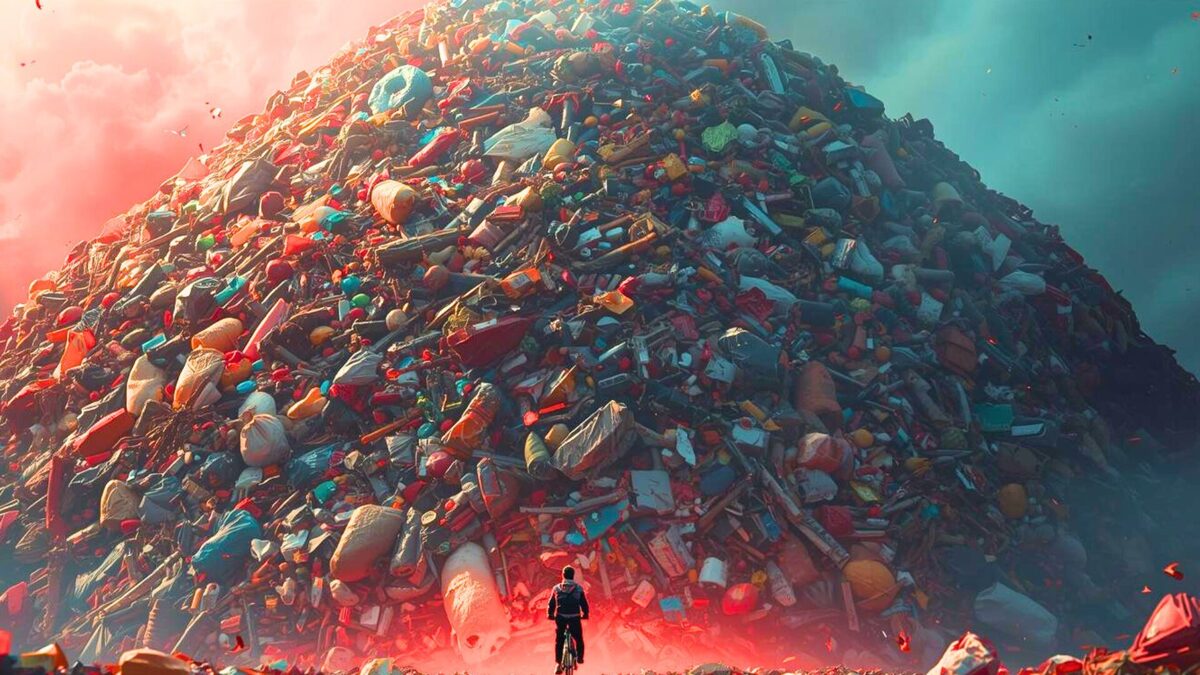
It is the dirty secret the UK’s £14.3bn food delivery industry is desperate to keep off your doorstep. While major delivery platforms and courier firms bombard consumers with ‘Net Zero’ pledges and ‘waste-less’ marketing campaigns, a new analysis reveals the sector is responsible for a staggering £2.3 billion in avoidable food waste this year alone.
The investigation exposes a systemic reliance on ‘greenwashing’—where companies like Just Eat, DPD, and Royal Mail hide behind eco-friendly slogans while their operational policies actively generate mountains of rotting food and packaging waste.
THE ‘WASTE-LESS’ LIE
The headline figure is driven largely by Just Eat, the market giant claiming to ‘tackle food waste’. Our analysis suggests they are responsible for £2.28bn of the total waste pile—approximately 16% of the entire market’s value.
While the company promotes ‘waste-less portion sizes’, their platform mechanics tell a different story. Minimum spend thresholds aggressively push customers to over-order, while their policy on failed deliveries is weak, shifting the blame for leftovers onto households rather than addressing the logistical failures that lead to cold, undeliverable food.
THE LOGISTICS OF DECAY
The scandal extends beyond the food platforms to the couriers that power them. These firms are happy to ship food for a premium price; the ‘Meal Kit’ sector alone is estimated to rely on the DPD, Royal Mail, and Evri networks for some 43 million boxes annually.
This means 43 million boxes a year are thrown into the ‘courier lottery’. With an industry average return/fail rate of at least 6% (though our research suggests it is closer to 10–12%), these couriers are responsible for 2.58 million failed deliveries, representing £103 million in wasted goods.
We investigated the ‘Friday Trap’—a scheduling failure where fresh food boxes undelivered on a Friday sit in depots over the weekend, destroying thousands of meals weekly. DPD markets itself as the ‘UK’s Sustainable Delivery Service’ with a shiny fleet of electric vehicles, yet their Terms & Conditions conveniently list perishables as ‘Prohibited Items’, allowing them to avoid liability for the waste they cause.
Royal Mail, despite its ‘Steps to Zero’ campaign, ranks #1 for delays. Automated hubs frequently ignore ‘Fresh Food’ priority stickers. In a practice insiders call ‘The Boomerang’, rotting food is driven back to the sender rather than being disposed of locally, effectively doubling the carbon footprint of the waste simply to avoid administrative paperwork.
Evri (formerly Hermes) claims to have the ‘greenest delivery fleet’ but holds a dismal customer satisfaction rating (31%). For food producers, a ‘lost parcel’ with Evri is often a euphemism for food rotting in a warehouse corner. Like DPD, they utilise ‘Prohibited Items’ clauses to auto-reject claims for spoilage.
ALGORITHMIC APATHY
The ‘gig economy’ players are equally culpable.
@Deliveroo promises a ‘sustainable future’, but its ‘Batching’ algorithm prioritises driver efficiency over food integrity, leading to cold food rejections. When a customer cannot be found within 10 minutes, riders are instructed via the app to ‘dispose of the food safely’—corporate-speak for throwing it in the bin.
UberEats, pledging ‘Zero Emissions’ by 2040, suffers from ‘Ghost Prep’ issues. Drivers ‘multi-apping’ (working for rival platforms simultaneously) leave food decaying in vehicles for extended periods. High refund rates for ‘cold food’ are used to mask the sheer volume of physical waste being generated.
THE HUMAN COST: FEEDING THE CRISIS
To understand the scale of this moral failure, we must translate the financial loss into human terms. The £2.3 billion wasted by this sector annually is not just money; it is lost nourishment in a country gripped by a cost-of-living crisis.
If that wasted capital were converted into food bank support, it would:
- Purchase 920 million hot meals (at a retail value of £2.50).
- Fund 76 million emergency food parcels (valued at £30 each).
- Feed every single person currently relying on a UK food bank three meals a day for the next ten years.
This waste is happening while businesses and charities like the Trussell Trust, The Felix Project, FareShare, and City Harvest fight daily against food poverty. At Tastes Good Does Good, we donate 15% of our revenue to fight food inequality, but the giants are undoing our work. They are feeding the landfill while we try to feed the people and fix a system they break every single day.
THE STARVING COURIER: A CYCLE OF POVERTY
Perhaps the most bitter irony of this scandal is the plight of the couriers themselves. While delivering £50 boxes of artisan food or £30 takeaways, many riders earn below the minimum wage and are trapped in the very poverty this system exacerbates.
Reports from the frontline reveal that a significant number of gig-economy riders—the human gears in this £14bn machine—are themselves forced to use food banks. They spend their days carrying hot food they cannot afford to eat, only to end their shifts queuing for handouts. By driving down wages to subsidise ‘free delivery’, the big platforms are locking their own workforce into a cycle of dependency.
THE ‘AFTERNOON TEA’ TAX: THE CAKERY HACK
The failure of these automated systems is so profound that our team at Cakery Wonderland has had to ‘hack’ the logistics network just to keep failed deliveries of afternoon tea boxes below 5%.
The solution? We treat the local depot workers to afternoon tea if they ensure our boxes are placed in the manual handling workstream. We also ensure the delivery notes on the digital scanner match the large pink stickers on our boxes: ‘Please deliver within 24 hours’. It has worked, but the alternative would be a significant hike in the cost of delivery or the product itself. This stands in stark contrast to a few years ago, when the business lost £6,600 and 200 customers over a Mothering Sunday weekend due to Evri.
The official system—the barcodes, the scanners, the ‘Next Day’ guarantees—is broken for fresh food. The only way to make it work is to bypass the robots and bribe the humans with kindness (and cakes).
REBALANCING THE SCALES: THE ‘BIOHAZARD TRAP’
Fed up with the ‘Return to Sender’ loop, where couriers attempt to return rotting food to avoid disposal costs, we have developed a ‘scorched earth’ policy. This came into effect after we purchased specialist ingredients from Scotland and paid £12.95 for next-day delivery on a Friday. Following a weekend of ‘pork pies’ (lies) from DPD tracking, they attempted delivery on the Monday evening. It cost us over £180 in additional labour to source replacement ingredients across London.
Now, we use the Biohazard Trap:
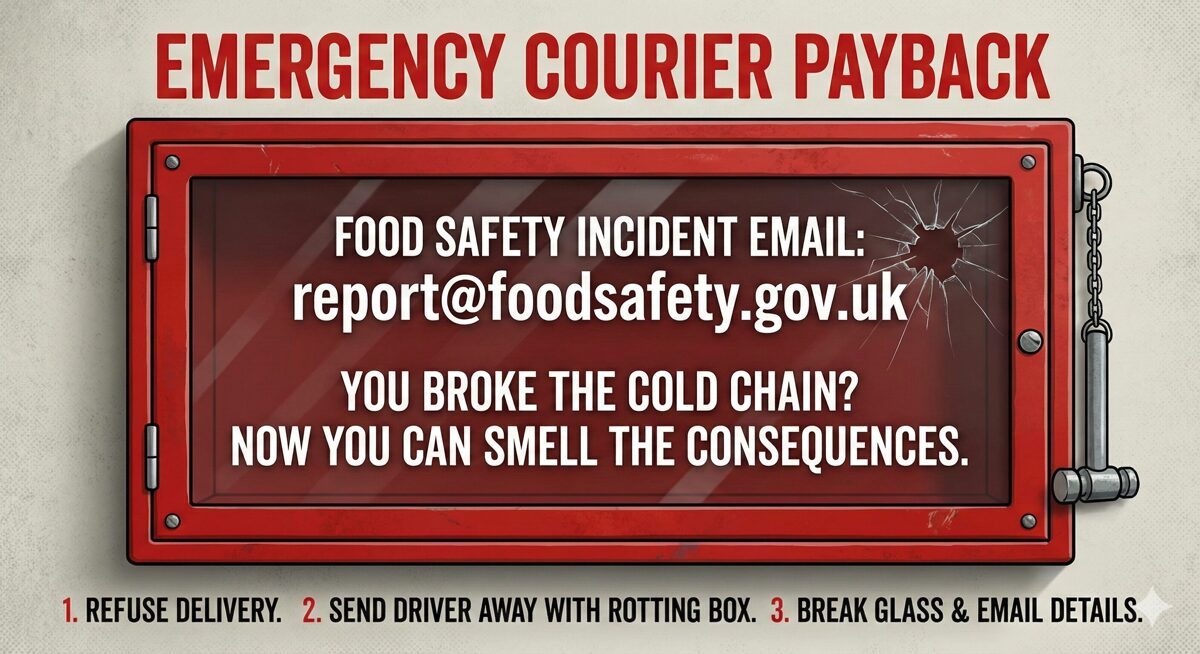
- The Return: When a courier fails a delivery and attempts to return the rotting package (the Boomerang), we refuse to accept it.
- The Call: With the rotting meat now legally back in the courier’s possession, we immediately email the local Environmental Health Officer (EHO).
- The Tip-Off: We report that a specific courier company is currently transporting ‘Category 3 Animal By-Products’ (rotting meat) in an unlicensed, un-refrigerated vehicle.
WHO IS RESPONSIBLE FOR DELIVERY WASTE? NO ONE.
The system is designed to make the waste invisible. The restaurant says, ‘It was fine when it left the kitchen’; the app says, ‘The rider tried to deliver it’; the courier says, ‘You shouldn't have sent perishables’. Because no one takes ownership of the food during transit, the £2.3bn of waste technically doesn't exist in anyone’s official sustainability report.
TURNING FAILURE INTO FINES
While they may claim to be contractually blameless, they are not above the law. When a courier depot finds a rotting box on a Monday morning, they are no longer handling ‘parcels’—they are handling Category 3 Animal By-Products (ABP).
What the Law Says (ABP Enforcement Regulations 2013)
- The Classification: Any meat, fish, or dairy no longer intended for human consumption (due to spoilage or failed delivery) is legally classified as Category 3 ABP.
- The Disposal Rule: Under UK law, it is strictly illegal to dispose of Category 3 ABP in general waste skips or landfill. It MUST be collected by a registered ABP carrier and taken to an approved rendering plant or incineration site.
WHAT THIS MEANS FOR COURIERS
Breaching these regulations is a criminal offence. Authorities (EHOs and APHA) have the power to levy significant penalties:
- Magistrates’ Court: Unlimited fines for each offence.
- Crown Court: Unlimited fines and severe corporate sanctions.
- Fixed Penalty Notices: Immediate fines from £200 to £5,000 for administrative failures.
- Custodial Sentences: Up to 2 years in prison for systemic illegal dumping.
- Operational Consequences: Fleet seizure and Depot Closures via Hygiene Emergency Prohibition Notices.
NO NEW LAW NEEDED JUST ENFORCE THE ONES WE HAVE
We have written to the a new Secretary of State at the helm of DEFRA Emma Reynolds MP to enforce the existing food safety standards. and get the Food Standards Agency (FSA) and local Trading Standards to conduct a series of unannounced, targeted spot-checks at major parcel distribution hubs specifically on Monday mornings between 6:00 AM and 9:00 AM. If the Government is serious about food security, it must inspect the supply chain at its weakest point, not when it is convenient for the couriers.
Food producers should write to customers and tell them not accept the goods if the more than at day late, explain why, then send a report to [email protected] XXXX courier company transporting Category 3 Animal By-Products (rotting meat) back and forth across the country in un-refrigerated vans. They are committing a criminal offence under the Animal By-Products (Enforcement) (England) Regulations 2013 (and equivalent acts in Scotland and Wales)
CONCLUSION: IS IT ALL IN VAIN?
For ethical producers watching this industrial-scale waste, the question is inevitable: Is our work in vain?
The answer is no. The £2.3bn waste mountain proves that the ‘Big Tech’ model of food delivery—prioritising speed, algorithms, and liability avoidance—is fundamentally broken. It is a dinosaur that eats money and excretes methane. Customers will eventually realise they are paying 30% to 40% more for their food to cover this unseen wastage.
Models like Tastes Good Does Good are the prototype for the only sustainable future. It is the ethical producers, fighting for every box and every meal, who are holding the line against a system that has forgotten the value of food.