
What if large companies had to create a new company that would help end food poverty ?
A few thousand pounds of existing capacity later, we had created a new product that generated enough revenue from a single event to purchase hundreds of tins of pet food. This micro-experiment sparked a macroeconomic question. Imagine if the CEO of every major food company in Britain received a simple challenge: You have 90 days and £1 million. You cannot create a charity, make a donation, or launch a CSR programme. You must deploy your existing infrastructure to create a commercially viable enterprise that reduces poverty, which will ultimately transition into community ownership.
Most corporate boards would instinctively push back, citing budget constraints and shareholder risk. But treating poverty as a permanent charity case rather than a venture creation challenge is a failure of commercial imagination.
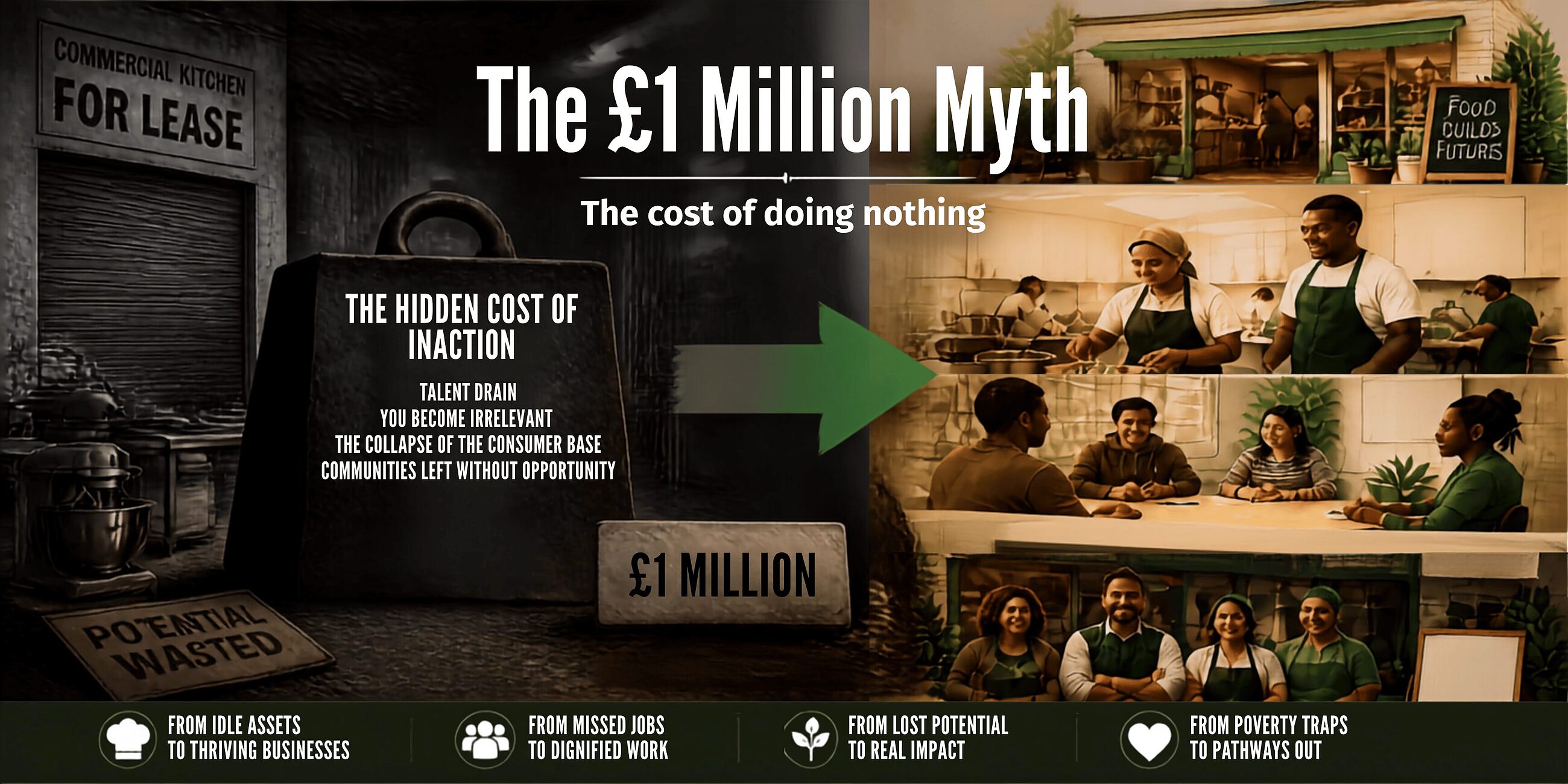
The £1 Million Myth and the Danger of Doing Nothing
When executives point to a £1 million price tag as a barrier, they are using financial prudence as an excuse for inaction. To meet this 90-day challenge, a major corporation does not need to write a cash cheque. They need to deploy underutilised capacity.
The factories, warehouses, distribution fleets, procurement teams, and intellectual property already exist. Running a production line for an extra weekend shift or allocating 10% of a food scientist's time to a 90-day sprint requires zero new capital; it is the redirection of sunk costs and kinetic energy.
The far greater financial risk is corporate inaction. If businesses continue to rely on the state to manage poverty, the macroeconomic consequences will hollow out their own markets. Food poverty currently impacts 8.1 million working-age adults, 4.2 million children, and 2.1 million pensioners in the UK
The Single-Generation Blueprint (2026–2056)
If we shift from treating poverty as a funding deficit to treating it as an asset-led venture, the outcomes over a single generation are staggering.
Suppose 1,000 major UK Food & Beverage enterprises accept this challenge. Factoring in a standard startup failure rate of 70%, 300 surviving anchor enterprises would emerge. Because these spin-outs are mandated to transition into Community Stewardship Trusts, 100% of their net profits would remain inside local Community Wealth Funds.
Over thirty years, the compounding profits of these non-extractive businesses unlock an estimated £412 billion in systemic value. This capital bypasses traditional philanthropy entirely, flowing directly into community infrastructure like rapid modular housing, universal free early childcare, and after-school youth protection clubs. By 2042, this blueprint shifts 15% of the total UK poverty deficit into self-sustaining market systems.
To secure internal stakeholder buy-in, executives must reframe this from a philanthropic loss to a strategic asset. A 90-day spin-out serves as the ultimate corporate R&D sandbox—a high-speed incubator to test sustainable supply chains and hyper-local marketing without risking the core brand. When the venture transitions to steward ownership, the parent company retains deeply authentic, permanent brand loyalty that traditional ESG reporting simply cannot buy.
Scaling the 15-75-25 Theory of Change
This 90-day corporate challenge is the macro-level expression of exactly what we are already doing. Tastes Good Does Good operates as a 10-year business and social experiment designed to prove that food and hospitality brands can put people and the planet before profit and shareholders
Our internal ecosystem is built entirely on this asset-repurposing philosophy, governed by our 15-75-25 model:
15% to Food Poverty: We commit 15% of our revenue—not just profit—to fighting hunger, using our wholesale buying power to supply food banks exactly what they need
75% to Young Chefs: We source talent via culinary colleges and gift up to 75% ownership of new profitable ventures to young chefs from disadvantaged backgrounds, providing them with real capital, kitchens, and first customers
25% to Community Wealth: We asset-lock the remaining 25% of every gifted venture at formation, transferring realised value into a local community wealth fund to build lasting infrastructure
Poverty will only end when we stop managing it and start building self-funding, purpose-driven systems that permanently shift economic power
If we were to map out a 90-day pilot for one of your existing corporate partners using this framework, which of their underutilised physical assets would be the easiest to deploy first?